East Texas · free service, no obligation
Septic System Installation Cost in East Texas
A new septic system costs about $3,500 to $8,500 for a conventional system and $10,000 to $20,000 for an aerobic unit, per national cost guides. Your soil decides which one your lot can have.
Request a call backFree to ask. No obligation.
Last reviewed
What a new septic system costs in 2026
A conventional septic system costs $3,500 to $8,500 installed, per HomeGuide, and an aerobic system costs $10,000 to $20,000, per HomeAdvisor. HomeAdvisor puts the national average at $8,016, with most projects between $3,590 and $12,463.
These are national figures. No public price survey covers East Texas alone, so treat them as a starting range, not a quote. The system your lot is allowed to have matters more than anything else on the bill.
| System type | National installed cost | Source |
|---|---|---|
| Conventional gravity (anaerobic) | $3,500 to $8,500 | HomeGuide |
| Chambered (gravel-less) | $4,000 to $11,000 | HomeGuide |
| Alternative systems, overall | $4,000 to $15,000 | HomeGuide |
| Drip distribution | $6,500 to $15,000 | HomeGuide |
| Aerobic treatment unit | $10,000 to $20,000 | HomeAdvisor |
| Mound | $25,000 to $50,000+ | HomeGuide |
| Engineered systems, overall | $15,000 to $50,000+ | HomeGuide |
The two guides price aerobic units differently. HomeGuide places an aerobic treatment unit in its engineered tier at $20,000 to $40,000+, so a higher aerobic quote is not automatically out of line.
Where the money goes
The tank is a small share of an installed price; labor, site work and the drain field make up most of it. HomeAdvisor estimates labor at 50% to 70% of the total, and HomeGuide lists installation labor at $1,500 to $4,000.
| Item | National range | Source |
|---|---|---|
| 1,000-gallon septic tank (tank only) | $1,000 to $1,500 | HomeGuide |
| Installation labor | $1,500 to $4,000 | HomeGuide |
| Permits, inspections and testing | $1,000 to $2,000 | HomeGuide |
| Soil test | $250 to $700 | HomeGuide |
| Deep hole percolation test by an engineer | up to $2,000 | HomeGuide |
| Distribution box | $500 to $1,500 | HomeAdvisor |
| Riser (easier access for future pumping) | $300 to $600 | HomeAdvisor |
Locally, the county permit fee itself is a few hundred dollars (see the county table below). The site evaluation and design are billed separately, so compare that whole line across quotes, not just the fee.
Tank size by bedrooms under Texas rules
Texas sets a minimum tank size from the home’s bedrooms and living area, not from bedrooms alone. The rule (30 TAC 285.91, Tables II and III) first assigns a daily wastewater flow, then sets the smallest tank allowed for that flow.
| Home | Flow with water saving fixtures | Minimum tank | Flow without | Minimum tank | Minimum aerobic capacity |
|---|---|---|---|---|---|
| 1 to 2 bedrooms, under 1,500 sq ft | 180 gal/day | 750 gal | 225 gal/day | 750 gal | 360 gal/day |
| 3 bedrooms, under 2,500 sq ft | 240 gal/day | 750 gal | 300 gal/day | 1,000 gal | 360 gal/day |
| 4 bedrooms, under 3,500 sq ft | 300 gal/day | 1,000 gal | 375 gal/day | 1,250 gal | 480 gal/day |
| 5 bedrooms, under 4,500 sq ft | 360 gal/day | 1,250 gal | 450 gal/day | 1,250 gal | 600 gal/day |
| 6 bedrooms, under 5,500 sq ft | 420 gal/day | 1,250 gal | 525 gal/day | 1,312.5 gal | 720 gal/day |
Two things follow. A 1,000-gallon tank covers up to four bedrooms with water saving fixtures, and a 1,500-gallon tank covers up to six bedrooms either way. The aerobic table in the same rule adds that a home with fewer bedrooms but more square footage moves up to the larger row.
These are minimums. Your designer can size up, and HomeGuide’s tank prices run from $700 to $1,200 for a 750-gallon tank to $1,500 to $2,500 for a 1,500-gallon one.
What raises the cost on East Texas lots
Soil is the biggest swing factor, because it decides whether a cheap gravity system is allowed at all. Texas A&M AgriLife says conventional gravity systems cannot be installed in clay soils, shallow soils, rock, soils that become saturated in wet periods, or soils with a high water table, and need two feet of separation from saturated or restrictive soil.
- Clay or shallow soil. When a gravity field will not work, the design moves to pressurized dispersal. AgriLife notes drip systems can go in clay, shallow soils and moderately saturated sites, but need at least one foot of unsaturated soil and an ongoing maintenance contract.
- High water table. Mound systems are built for sites with little soil above groundwater, impermeable soils or bedrock, per AgriLife, and HomeGuide prices them at $25,000 to $50,000+.
- Slope. AgriLife says not to use a mound on slopes over 10 percent; drip systems with pressure compensating emitters can work on fairly steep slopes.
- Trees. AgriLife warns that roots from trees planted too close to the treatment area can clog distribution pipes, so wooded lots may need clearing or a different layout.
- Lot size. Gregg County’s checklist sets a conventional design minimum of half an acre with community water or one acre with a private well.
- Labor and access. HomeGuide notes that mound, aerobic and pressure distribution systems take more labor to install pumps and piping.
Permits and the site evaluation
Nearly every new system starts with a site evaluation and a permit from your local permitting authority. TCEQ says a permit and an approved plan are required to build, alter, repair or extend an on-site sewage facility (OSSF).
- Site evaluation. A TCEQ licensed site evaluator or a professional engineer surveys the lot and analyzes the soil where the system will go.
- Design. The results decide which system types the lot supports; nonstandard systems need a professional design.
- Application. The application, planning materials and fee go to your permitting authority, which must approve or deny them within 30 days.
- Authorization to construct. Harrison County’s authorization is valid for one year from issue.
- Installation and inspection. The system is inspected before it is covered, then a notice of approval is issued.
Published county fees for a single family system:
| County | Permit office | Fee |
|---|---|---|
| Smith (Tyler, Lindale, Whitehouse, Bullard) | Smith County OSSF program, run by contractor RTS Environmental LLC | Not published on the county page |
| Gregg (Longview, Kilgore, White Oak) | Gregg County Health Department | $350, conventional or professionally designed |
| Harrison (Marshall, Hallsville) | Harrison County Environmental Health | $360 |
| Rusk | Rusk County On-Site Septic Inspection | Not published; call the office |
For Smith County, see the Tyler page. For Van Zandt, Wood and Cherokee, see the Canton, Mineola and Jacksonville pages. For any other county, look up your permitting authority with TCEQ’s county search. Where no local program exists, the TCEQ regional office issues the permit. Our installation service page walks through the process in more detail.
For Upshur County, see the Gilmer page.
For Rusk County, see the Henderson page.
Our septic permits by county guide lists every county’s permit office and covers the 10 acre rule in full.
The 10 acre question
A single family home on 10 acres or more can skip the permit, but not the rules. Texas Health and Safety Code 366.052 and 30 TAC 285.3 exempt it from planning materials, the permit and inspections only if all of these are true:
- A TCEQ licensed site evaluator or professional engineer evaluates the site (TCEQ’s wording).
- The system meets every design and construction standard in Chapter 285.
- It causes no nuisance and does not pollute groundwater.
- Every part is at least 100 feet from the property line.
- Effluent stays on the property.
- The house is the only dwelling on the tract.
What it does not do: it does not lower the price of the system, which still has to be built to the same standards. TCEQ says local programs can be stricter, so confirm with your county first. Harrison County states that a second home on the tract makes it multifamily, and a permit is then required.
Conventional vs aerobic: the cost after installation
Aerobic systems cost more to own, not just to install, because Texas requires ongoing maintenance. Table XII of 30 TAC 285.91 requires no maintenance contract for a septic tank with a standard absorptive field, but does require one for secondary treatment systems such as aerobic units.
| Conventional | Aerobic | |
|---|---|---|
| Installed cost (national) | $3,500 to $8,500 (HomeGuide) | $10,000 to $20,000 (HomeAdvisor) |
| Maintenance contract | Not required | Initial two-year service policy required before approval |
| After two years | Pump as needed | Maintain it yourself where allowed, or sign a new contract |
| Reporting | None | Provider reports at least every four months |
| Routine upkeep | Pumping every three to five years (TCEQ) | Chlorine tablets, sludge checks, repairs the provider flags |
Under 30 TAC 285.7, the signed two-year policy goes to the permitting authority before the system is approved for use. TCEQ notes some permitting authorities restrict or bar homeowner maintenance afterward. No public source publishes typical contract prices, so ask for the annual price in writing before you choose. Pumping a 1,000-gallon tank runs $300 to $700, per HomeGuide; see our pumping cost guide and the Texas aerobic rules.
Questions to ask an installer
A written, itemized quote is the easiest way to compare bids.
- Is the quote itemized: site evaluation, design, permit fee, tank, dispersal field, labor, electrical?
- Which system types did the site evaluation allow, and why this one?
- Who holds the TCEQ license for the site evaluation and the installation?
- Does the price include the county permit and any reinspection fee?
- For an aerobic unit, what does the two-year service policy cover, and what will a contract cost after it?
- Will risers be installed so future pumping is easier?
Once it is in, our septic maintenance guide covers upkeep, and a septic inspection is worth it when you buy land with an existing system.
Pricing for your lot
Only a site evaluation turns national ranges into a real number for your property. To get pricing for your lot in Longview, Marshall, Kilgore or nearby, request a call back and we’ll get the site evaluation and pricing set up from there.
Sources
- HomeGuide, septic system cost: https://homeguide.com/costs/septic-tank-system-cost
- HomeGuide, septic pumping cost: https://homeguide.com/costs/septic-tank-pumping-cost
- HomeAdvisor, septic system installation cost (updated Jun 20, 2026): https://www.homeadvisor.com/cost/plumbing/install-a-septic-tank/
- Smith County OSSF program: https://www.smith-county.com/507/On-Site-Sewage-Facility
- TCEQ, getting a permit for an OSSF: https://www.tceq.texas.gov/permitting/ossf/ossfpermits.html
- TCEQ, OSSF maintenance: https://www.tceq.texas.gov/permitting/ossf/ossfmaintenance.html
- 30 TAC 285.3, general requirements and exceptions: https://www.law.cornell.edu/regulations/texas/30-Tex-Admin-Code-SS-285-3
- 30 TAC 285.7, maintenance requirements: https://www.law.cornell.edu/regulations/texas/30-Tex-Admin-Code-SS-285-7
- 30 TAC 285.91, tables: https://www.law.cornell.edu/regulations/texas/30-Tex-Admin-Code-SS-285-91
- Texas Health and Safety Code Chapter 366: https://statutes.capitol.texas.gov/Docs/HS/htm/HS.366.htm
- Texas A&M AgriLife, conventional septic system fact sheet: https://ossf.tamu.edu/files/2023/01/L-5234-8.99-Conventional-septic-tank-drain-field.pdf
- Texas A&M AgriLife, subsurface drip fact sheet: https://ossf.tamu.edu/files/2023/01/L-5237-8.99-Subsurface-drip-distribution.pdf
- Texas A&M AgriLife, mound system fact sheet: https://ossf.tamu.edu/files/2023/01/L-5414-4.02-Mound-System.pdf
- Texas A&M AgriLife OSSF, frequently asked questions: https://ossf.tamu.edu/frequently-asked-questions/
- Gregg County Health Department permit checklist: https://greggcounty.texas.gov/assets/main/septic-systems-info/gregg-county-health-dept-permit-checklist.pdf
- Harrison County Environmental Health permit process: https://www.harrisoncountytexas.gov/upload/page/0083/HCEH%20Documents/HCEH%20Permitting%20process.pdf
- TCEQ permitting authority search by county: https://www6.tceq.texas.gov/oars/index.cfm?fuseaction=search.county
Common questions
What is the average cost to put in a new septic system?
HomeAdvisor puts the national average at $8,016, with most projects between $3,590 and $12,463. By system type, HomeGuide lists a conventional system at $3,500 to $8,500 installed, and HomeAdvisor lists an aerobic system at $10,000 to $20,000. These are national figures; the price for your lot depends on what your site evaluation allows.
How many bedrooms will a 1,000 gallon septic tank support in Texas?
Under the Texas sizing tables in 30 TAC 285.91, a 1,000 gallon tank meets the minimum for a four bedroom home under 3,500 square feet when the house has water saving fixtures, or a three bedroom home under 2,500 square feet without them. Your site evaluator or designer confirms the final size.
How many bedrooms will a 1,500 gallon septic tank support?
Under the same Texas tables, a 1,500 gallon tank is at or above the minimum for homes up to six bedrooms and 5,500 square feet, with or without water saving fixtures. Larger homes add flow for every extra 1,500 square feet, so a designer should run the numbers for anything bigger.
How much is a septic tank for a 2,000 square foot house?
A 2,000 square foot home with three bedrooms or fewer falls in the Texas usage row for homes under 2,500 square feet, which calls for at least a 750 gallon tank with water saving fixtures or 1,000 gallons without. HomeGuide lists a 1,000 gallon tank at $1,000 to $1,500 for the tank alone, before labor, drain field and permits.
How much does a 1,000 gallon concrete septic tank cost?
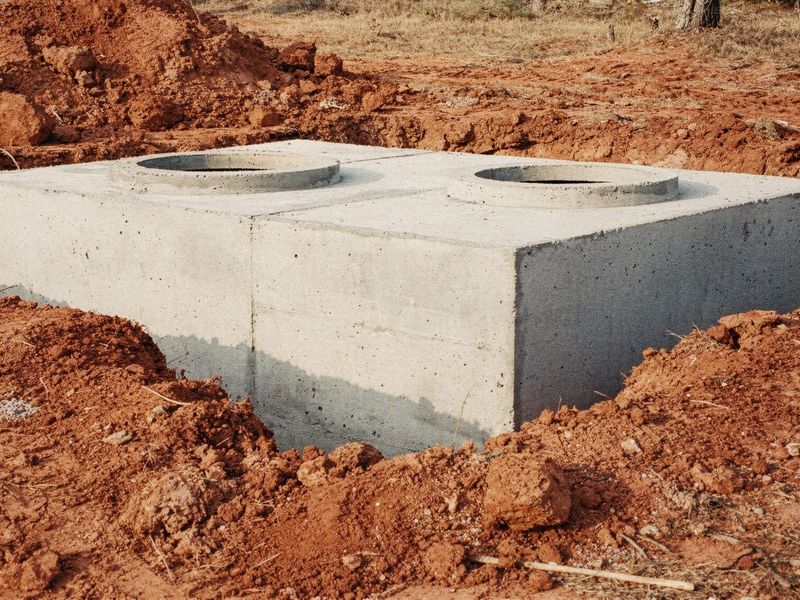
HomeGuide lists a 1,000 gallon tank at $1,000 to $1,500 and concrete tanks in general at $1,000 to $3,000 depending on size. That is the tank only. Excavation, the drain field, labor and permits make up most of an installed price.
Related help
- Aerobic SystemsAerobic treatment units run on Texas-specific maintenance rules. We'll get yours serviced, inspected and maintained by a licensed provider.
- InspectionBuying or selling a home, or just want to know your system's condition? We'll get your conventional or aerobic septic system inspected.
- InstallationNew construction, a failed system or an addition all can mean a new septic system. We'll get your Texas OSSF permitting and installation handled.
- Septic Permits by CountyWhich office permits a septic system in each East Texas county this site covers, when Texas law requires a permit, and what the 10 acre rule does and does not exempt.
- Pumping Cost GuideSeptic tank pumping costs about $300 to $700 for a typical 1,000 gallon tank, or $0.30 to $0.70 per gallon, in HomeGuide's national data. Rural access, buried lids and long hose runs add to that in East Texas.
Areas we cover
Request a call back
Tell us what’s going on
Leave your number and where you are, and we'll call you back, free and with no obligation.